

Despite Trump/DOJ Rants, Judge Rejects SPLC's Vindictive Prosecution Claims
Despite public attacks from President Donald Trump and DOJ leadership, a federal ruling says defense lawyers can't probe prosecutors' motives.

You won’t find reporting and analysis like this anywhere else—and it’s only possible because of subscribers who support this effort. Thank you! — Phil
This much seems indisputable:
Donald Trump’s administration viewed the Southern Poverty Law Center as an enemy, and officials were ecstatic in their celebrations of the indictment of the legendary civil rights organization on federal fraud charges.
“This is another Democratic hoax,” the president declared after his Justice Department indicted a group that had often been critical of his policies.
As a result, SPLC lawyers had argued the administration’s often-hyperbolic statements justified a motion to dismiss the indictment for vindictive prosecution—or, at least, to allow the defense to dig into prosecutors’ motives.
But in a 39-page opinion released Friday, U.S. District Judge Emily C. Marks rejected the SPLC’s motion—in essence, because there are no DOJ fingerprints on Acting U.S. Attorney Kevin Davidson’s decision to seek the indictment.
And, to continue the metaphor, defense attorneys will not be able to dust the case for any such prints.
“The Court has little trouble concluding that the SPLC offers insufficient objective evidence that Mr. Davidson or any other prosecutor in the Middle District of Alabama was vindictively motivated to indict the SPLC for the exercise of its First Amendment rights,” Marks wrote.
“Nor does the SPLC provide evidence that Mr. Davidson was directed to bring the present charges by a superior with a vindictive motive.”
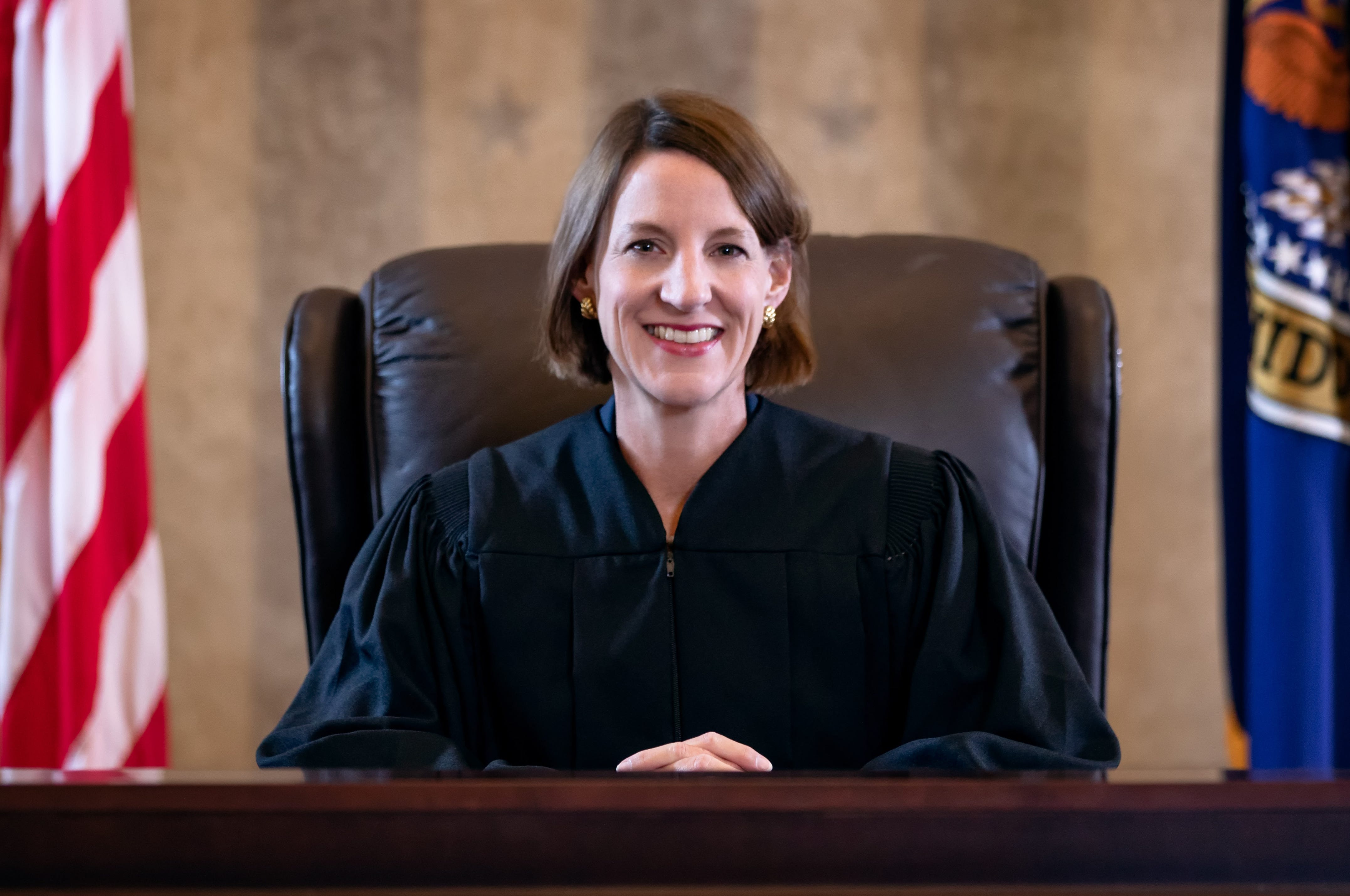
At the center of the indictment are questions about millions of dollars the group spent to operate an informant program that, Attorney General Todd Blanche argued, was “manufacturing racism to justify its existence.”
The SPLC has emphatically rejected such allegations.
In her opinion, Judge Marks—a Trump appointee and Federalist Society member—blasted both the government and defense for legal briefs that read “like much of our modern political discourse, heavy on heated rhetoric, better suited for cable news, or a podcast”—ignoring the normal admonitions that prosecutors must be held to a higher standard in order to protect the rights of the accused.
Marks even gave Attorney General Todd Blanche credit, in his announcement of the SPLC indictment, for saying: “The indictment speaks for itself. I’m not going to talk outside the four corners of the indictment.”
In fact, as my previous posts have shown, the evidence demonstrates that Blanche and DOJ officials have often strayed outside those four corners.
And, as you will see below, Judge Marks’ decision overlooks or downplays many of the SPLC’s arguments.
You can read my prior reporting on the SPLC indictment here.
Let’s break it down
‘Whistleblower reports’
“In the days immediately following the announcement of charges, whistleblower reports filed with congressional lawmakers accused top Justice Department officials of pressuring prosecutors to rush an indictment of the SPLC, despite significant concerns about the merits of the case.”
That argument, contained in the SPLC motion, relies on accusations in an April 2026 letter from House Democrats Jamie Raskin and Mary Gay Scanlon.
But, in her opinion, Judge Marks appears to completely ignore the whistleblower issue.
Trump: SPLC ‘a total scam’
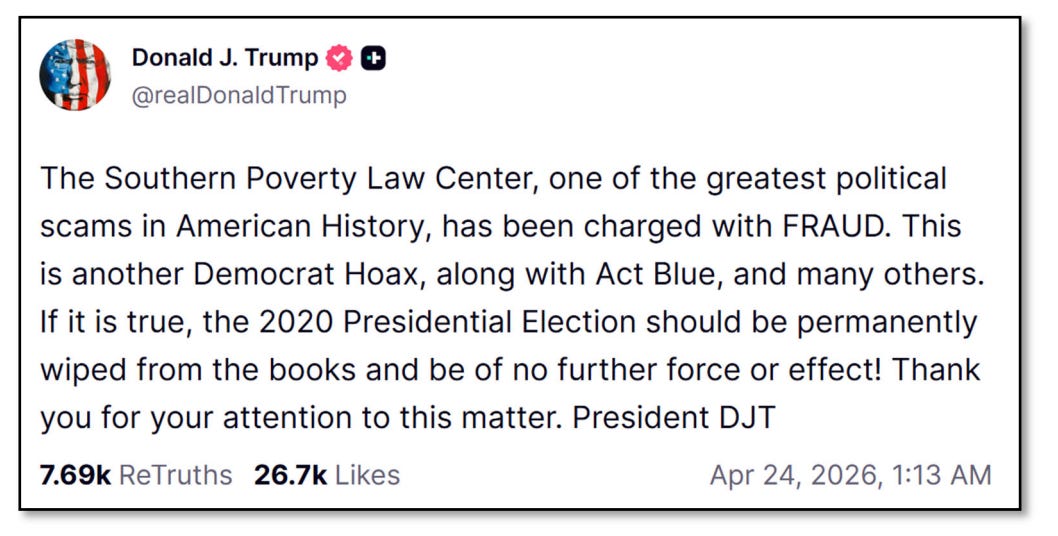
The president of the United States—whom the Trump administration has argued is the nation’s real chief law enforcement officer—celebrated the SPLC indictment in a Truth Social post that called the group “one of the greatest political scams in American History.”
During an appearance on 60 Minutes after the indictment, Trump called the SPLC “a total scam run by the Democrats” and claimed the group “funded” the deadly Unite the Right rally in Charlottesville in 2017 “to make me look bad.”
And, in an Oval Office press conference, he claimed the SPLC was “actually supporting” hate groups and that they “want to rig elections.”
Yet, Judge Marks seems to have embraced what some might call the “crazy uncle” view of the president’s rantings:
“President Trump’s rhetoric is (rather famously) wide-ranging, and he has undoubtedly been critical of the SPLC. However, the SPLC fails to establish that President Trump’s statements evince animus on the part of the United States Attorney for the Middle District of Alabama.”
In other words, “he says a lot of crazy stuff, but you cannot prove that the prosecutors who work for him were following his lead.”
Marks’ ruling also ignores a history with the Trump administration of the president personally calling on Attorney General Pam Bondi to target his enemies, as well as the finding by a federal judge in Nashville that the administration had engaged in vindictive prosecution of Abrego Garcia.
Patel: SPLC ‘inspired violence’
In October 2025, the SPLC joined more than 300 other non-profit groups in denouncing President Trump’s National Security Presidential Memorandum 7 as a “reprehensible and dangerous” effort to “defund, discredit, and dismantle nonprofit groups” in violation of the First Amendment.
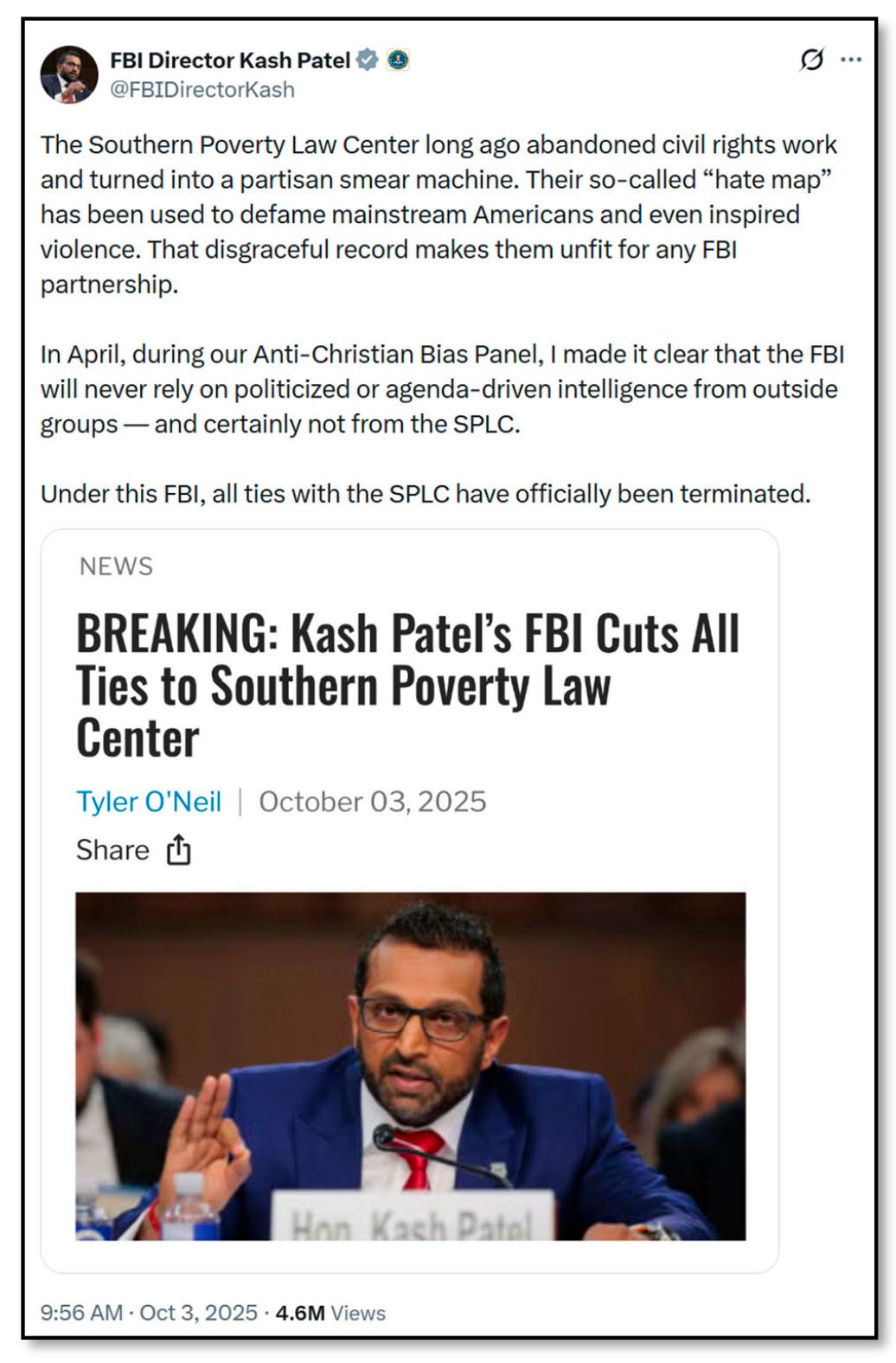
Two days later, FBI Director Kash Patel announced the Bureau was ending its cooperation with the SPLC, saying it had “even inspired violence.”
Again, Judge Marks saw no reason to explore whether Patel’s public statements were part of a DOJ agenda to bring down the SPLC.
“There is no evidence that Mr. Patel or the FBI’s perceived ‘ill will . . . actually motivated [the SPLC’s] prosecution,’” Marks wrote.
And the SPLC, the ruling continued, would not be able to use the legal process to look for any such evidence.
Dhillon: SPLC indictment ‘personal’
Assistant Attorney General for Civil Rights Harmeet Dhillon told Newsmax in April that the SPLC indictment was “personal” to her because she has seen “a lot of journalist friends . . . and groups that I’ve represented who have been targeted by the Southern Poverty Law Center.”
As a result, Dhillon continued, “It’s about time that we see some accountability.”
“In other words,” defense lawyers argued, “a high-ranking DOJ official said that if the SPLC criticized one of Dhillon’s ‘friends,’ criminal charges were the appropriate response.”
Again, Judge Marks found nothing in those remarks to justify exploring whether the DOJ was engaged in a vendetta.
“Whatever alleged animus Ms. Dhillon has for the SPLC, the SPLC fails to link that animus or her comments to the United States Attorney’s decision to charge the organization,” the opinion said.
Back in June, Marks ruled that the SPLC could not have access to grand jury transcripts to determine how prosecutors presented their case.
Show me the evidence!
Meanwhile, SPLC lawyers have filed a new motion asking Judge Marks to order the DOJ to turn over exculpatory evidence that might show the group was not guilty of the charges brought by the Trump administration.
Here’s the basic argument:
“The Superseding Indictment charges that the Southern Poverty Law Center (SPLC) secretly used donor funds to pay informants ‘engaged in the active promotion of racist groups[.]’
“Information in the government’s possession showing the opposite—that the SPLC utilized informants to disrupt and dismantle these groups—constitutes exculpatory material that must be produced to the defense.
“Evidence demonstrating that rather than seeking to conceal the existence of its informant program, the SPLC actually shared information generated by that program with law enforcement is likewise material and favorable to the defense.
“Documents showing the SPLC’s coordination with law enforcement exist, and the government could readily collect and produce them. That should have happened without the need for a request or this motion. It did not.”
What do you think?